ANDREW RILEY .

Technology leader / Architect / Builder

Turning complex technology into meaningful outcomes.

I'm Andrew Riley — Riles to most people. I connect business ambition with technical reality. From enterprise transformation to hands-on AI systems, I help people understand what's possible, build what's useful and make change stick.

Portrait of Andrew Riley

75

Partner architects in the planned ANZ exchange cohort

Cisco Partner Architect Exchange · 2019

Read the event post →

3,000

Users in enterprise and government architecture projects

Lead architect · UXC · 2009

Explore the career context →

16

Global communications platforms deployed

Strategy and implementation · Servcorp · 2001–2005

Explore the engineering background →

Experience that connects strategy and execution

Lead the people. Architect the path. Build to learn.

These are three connected parts of how I work. Leading teams taught me how to create shared direction. Architecture taught me to connect ambition with constraints. Engineering keeps those decisions grounded in how systems behave.

Leader

Build capability that outlasts a project.

At Google Cloud, I led the ANZ technology and architecture team, with responsibility for people, performance and customer coverage. At Cisco, I led partner and NSW architecture teams and served as deputy CTO in customer, partner and media engagements. Leadership also means bringing people together to learn and put ideas to work.

Architect

Connect the business goal to a workable system.

My architecture work spans global enterprise accounts, cloud transformation and digital healthcare. As lead architect for IBM across APJC and India, I helped set the direction for multi-year architecture projects. In healthcare, the focus became patient experience, repeatable capabilities and resilient foundations: understanding the service before choosing the technology.

Builder

Stay close enough to the work to test the idea.

At Servcorp, I defined and implemented deployment strategies for 16 global communications platforms; at Getronics, I implemented enterprise and government collaboration systems. That engineering instinct continues in field experiments and my personal lab, where I build integrations, test AI agents and use observability to understand what actually happens.

Explore the career behind the work →

Selected work

Strategy in the boardroom. Curiosity at the workbench.

Personal lab · Applied AI

Designing AI systems with boundaries

Exploring agent identities, scoped permissions, approval gates and observable behaviour as foundations for trustworthy systems.

Personal experiments, not production customer deployments.

Explore the work →

Professional experience · Leadership

Leading teams through technology change

Building architecture capability, developing people and helping enterprise customers navigate complex technology decisions.

Cisco and Google Cloud architecture leadership.

Explore the work →

Personal projects · Engineering

Building to understand

Using homelab infrastructure, automation and AI tooling to make ideas tangible, test assumptions and share practical lessons.

Hands-on projects and writing archive.

Explore the work →

How I work

Start with the need, make the architecture explicit, build something testable, help people use it, and learn from the result. Here is what that looks like in the journal.

  1. 01

    Discover

    Understand the experience people need before selecting a platform.

    Professional perspective · Digital health

    Start with the virtual care service

    I asked whether a platform could support changing care models, multidisciplinary teams and different patient experiences. Those questions shape the requirements before the technology choice.

    Read the discover example →
  2. 02

    Architect

    Give each part of the system a clear responsibility.

    Personal lab · AI architecture

    Separate three kinds of AI memory

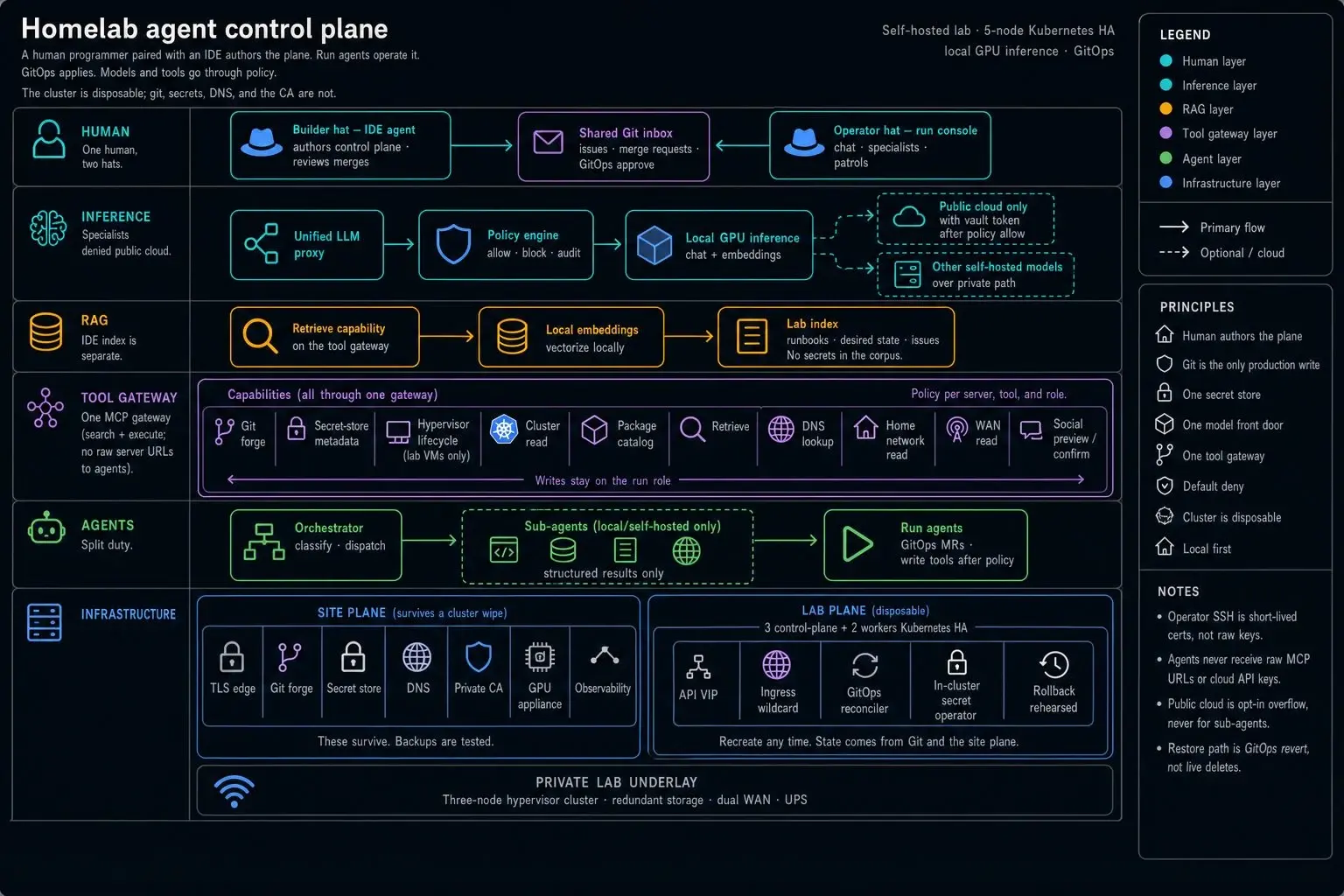
    In my multi-agent lab, Git holds reviewed decisions, an episodic API holds session history, and each harness keeps its own scratchpad. The design makes authority and hand-offs explicit.

    Read the architect example →
  3. 03

    Build

    Make the idea tangible and test it in its intended setting.

    Professional experiment · Regional connectivity

    Take a telehealth prototype into the field

    I connected a digital stethoscope to Webex over Starlink and tested calls from a regional NSW location with no 4G throughput. It explored what was possible and identified the need for more rigorous testing.

    Read the build example →
  4. 04

    Enable

    Help others develop the capability to act.

    Professional community · Partner capability

    Bring partner architects together

    I helped bring the Cisco Partner Architect Exchange to life, with a planned cohort of 75 architects from Australia and New Zealand: a shared forum for the people helping customers operate and transform.

    Read the enable example →
  5. 05

    Learn

    Use observed behaviour to improve the next decision.

    Personal lab · Testing assumptions

    Choose the model for the job

    When reasoning models added narration, latency and malformed tool calls to my agent workflow, I switched model class. The lesson: judge fit by useful output, resource cost and human cleanup.

    Read the learn example →

More than the work

Curiosity doesn't clock off.

I'm a technologist, leader, maker, DJ and lifelong learner. Music, family, wellbeing and hands-on projects bring different perspectives to the same things I value professionally: curiosity, creativity, connection and continual improvement.

Beyond work →
DJ Riles performing

Notes from the workbench.

Experiments, decisions and lessons from building and leading.

Read the journal →

Good conversations lead to interesting possibilities.

Interested in technology, architecture, AI or collaboration? I'd be glad to hear from you.

Let's connect